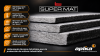
Hydrophobic thermal insulation: corrosion under insulation (CUI) control and industrial energy efficiency
THERMAL INSULATION | CORROSION CONTROL (CUI) | ENERGY EFFICIENCY
LEWCO SUPER MAT: hydrophobic thermal insulation for industrial asset protection
A flexible glass-fibre blanket impregnated with fluororesins, designed to reduce moisture retention, help mitigate corrosion under insulation and preserve the thermal performance of industrial piping and equipment.
Abstract
How can industrial facilities conserve process energy without encouraging moisture accumulation beneath insulation? LEWCO SUPER MAT offers a flexible, hydrophobic alternative for piping and equipment operating under demanding conditions. Its STC variant incorporates a silicone weather barrier. Both solutions support an integrated approach to insulation selection: thermal protection, moisture management, ease of installation and maintenance. These characteristics are particularly relevant to Colombian industrial facilities exposed to rainfall and humid environments.
Corrosion under insulation: a hidden threat
Thermal insulation protects personnel, limits heat loss and supports process stability. However, water can enter through joints, penetrations or damaged jacketing and remain in contact with the metal. Heating and cooling cycles may also promote moisture accumulation. The resulting corrosion can progress without obvious external signs, with consequences for wall thickness, equipment availability and asset safety.
In Colombia, coastal facilities, plants exposed to frequent rainfall and intermittently operated equipment warrant particular attention. Insulation selection should consider the actual exposure of each asset, not only its operating temperature.
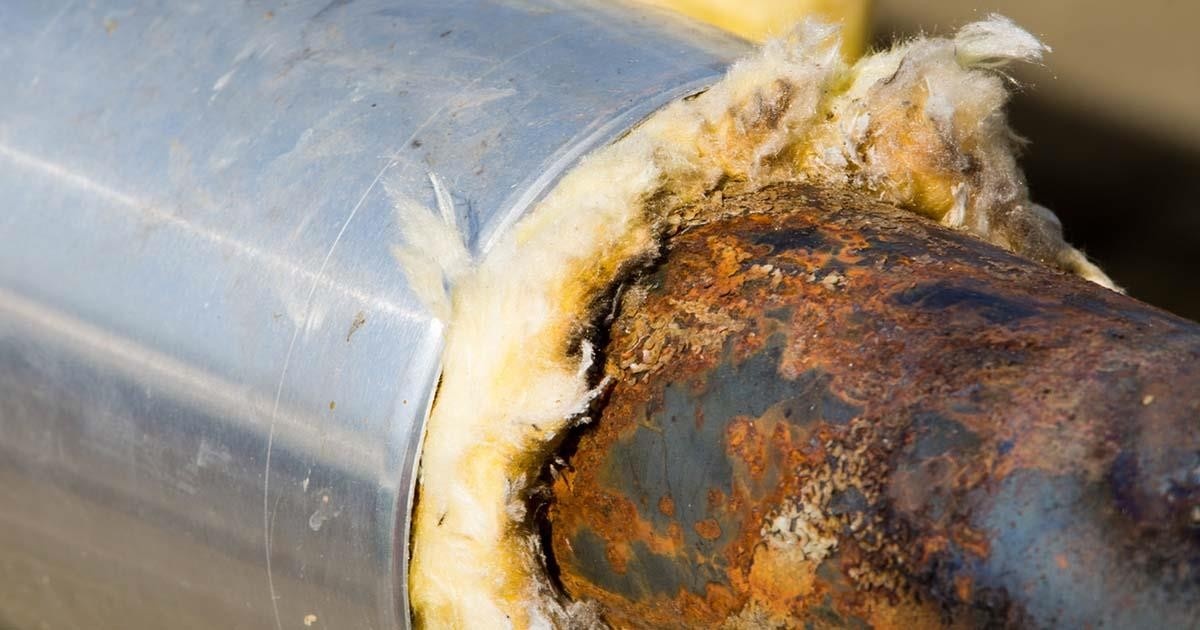
Moisture also carries an energy cost
Wet insulation can lose part of its ability to limit heat transfer. For example, at 149 °C (300 °F), an illustrative case compares annual heat losses of 547,000 BTU per foot of pipe with dry insulation and 1,410,000 BTU per foot with a water content of 12%. Heat loss with wet insulation is approximately 2.6 times greater. Although the outcome depends on the insulation system and operating conditions, this example highlights the importance of keeping insulation dry to conserve process energy.
How does LEWCO SUPER MAT work?
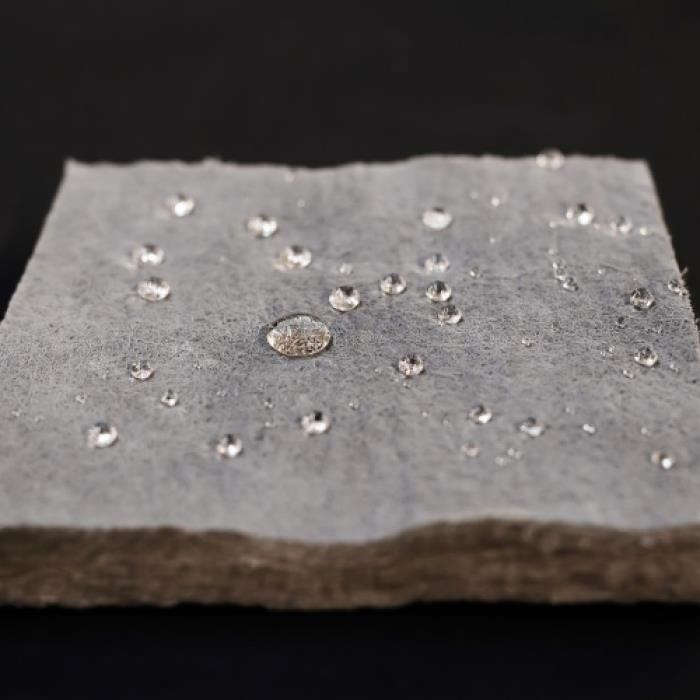
LEWCO SUPER MAT combines glass fibres with fluorocarbon resins to form a flexible blanket that repels liquid water while allowing water vapour to pass through. This combination helps limit moisture retention within the insulation. Its flexible format facilitates cutting and fitting around piping and complex components, with no dust generation reported by the manufacturer. In removable configurations, the blanket can also facilitate inspection access and subsequent reuse, provided it remains in suitable condition.
SUPER MAT and SUPER MAT STC: which to select?
SUPER MAT is the flexible hydrophobic blanket; SUPER MAT STC incorporates an approximately 1 mm silicone coating on one side which, according to the manufacturer, preserves breathability and provides a weather barrier. STC may replace metal jacketing where its mechanical protection or other service requirements are not needed. Hydrophobicity does not mean the installed system is waterproof.
Technical performance: data for specification
Selecting industrial insulation requires an understanding of its behaviour when exposed to water, temperature and service conditions. The following table summarises the declared properties of SUPER MAT STC and the corresponding evaluation methods.
| Property | Method | Result |
|---|---|---|
| Water vapour absorption | ASTM C1104 | <1 % |
| Immersion water absorption | ASTM C1763 B | <5 % |
| Water retention after thermal ageing | ASTM C1511 | <5 % |
| Linear shrinkage | ASTM C356 | <2 % @ 649 °C |
| Austenitic stainless steel compatibility | ASTM C795 | Pass* |
| Flame spread / smoke developed | ASTM E84 | FSI 5 / SDI 75 |
| Thermal conductivity at 100 / 300°C | ASTM C177 | 0.0434 / 0.0712 W/(m·K) |
| Thicknesses | — | 8, 16, 20, 25 mm |
| Density | — | 144–192 kg/m³ |
The maximum E-glass service temperature (approximately 650°C) must not be confused with continuous hydrophobic performance (315°C). The manufacturer does not recommend indoor applications on equipment operating above 315°C; above this limit, ventilation, service conditions and manufacturer instructions must be assessed.
Benefits for asset integrity management
Comparison with conventional insulation solutions
| Criterion | Conventional fibrous thermal insulation | LEWCO SUPER MAT / STC |
|---|---|---|
| Moisture behaviour | Varies according to the material and its external protection | Hydrophobic and breathable technology |
| Corrosion under insulation (CUI) | Risk associated with moisture accumulation and retention | Helps reduce moisture retention and CUI risk |
| External protection | Generally requires suitable external protection | STC may replace metal jacketing where service conditions permit |
| Installation | May require multiple components and specialised tools | Flexible material, easy to handle and install |
| Inspection and maintenance | May require replacement of deteriorated insulation | Potential for removal and reuse, depending on condition and design |
| Thermal performance | May be affected by moisture accumulation | Helps preserve thermal performance through moisture management |
| Operating costs | Associated with installation, maintenance and replacement | Potential for cost reduction throughout the system’s life cycle |
The true cost of insulation: beyond the material
The purchase price of insulation is only one part of the investment. Installation also involves labour, quality control, access, transport, storage and, where applicable, fabrication and installation of metal jacketing. The SUPER MAT roll format facilitates handling and transport. Where STC allows metal jacketing to be omitted, installation operations may also be simplified.
These advantages are particularly relevant to pipe racks, restricted-access areas and projects with demanding schedules. An economic assessment should also consider scaffolding, rework, replacement of damaged insulation and disposal, together with maintenance requirements throughout the asset’s service life.
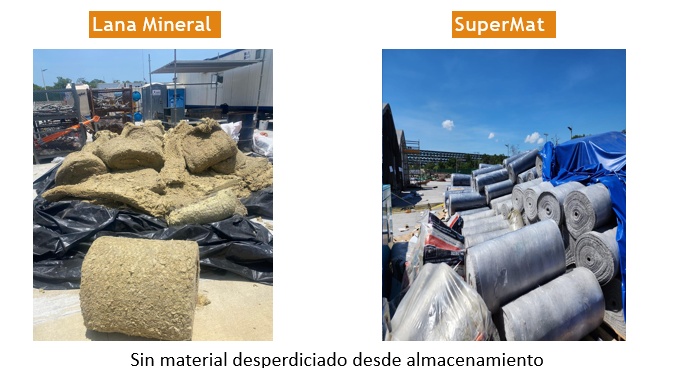
Industrial case: Olmeca refinery, Mexico
At the Olmeca refinery in Mexico, insulation installation was reported for piping ranging from 2 to 24 inches NPS (12 inches on average), operating at temperatures up to 200 °C. The reported daily installation rate was 50–60 linear metres with mineral wool and 100–120 linear metres with SUPER MAT. The case illustrates how simplified installation operations can contribute to improved project productivity.
| Mineral wool | SUPER MAT |
|---|---|
| 50–60 m/day | 100–120 m/day |
Productivity in other projects will depend on geometry, access, installation crews and service requirements. These results therefore provide a project reference rather than a performance guarantee.
Where can it add value in Colombia?
- Refining and petrochemicals: hot piping, valves, flanges and process equipment exposed to weather.
- Power generation: steam networks and thermal equipment.
- Chemical and manufacturing industries: thermal utilities and complex geometries.
- Maintenance and integrity: removable configurations to facilitate inspections where the design allows reuse.
Key considerations before installation
- Operating temperature, thermal cycles and service conditions.
- Environmental exposure, moisture and CUI risk.
- Required thickness based on energy conservation and personnel protection objectives.
- Substrate condition and compatibility with the corrosion protection system.
- Selection of SUPER MAT or STC, joints, sealing, drainage and external mechanical protection.
- Installation, inspection and maintenance criteria.
From selection to an integrated CUI strategy
An effective system requires assessment of operating temperatures and cycles, environmental exposure, substrate, compatible protective coatings, joints, sealing, drainage, mechanical protection and inspection. Thickness should be determined through thermal calculations based on energy conservation and personnel protection objectives. SUPER MAT complements these measures; it does not replace corrosion-resistant coatings or eliminate the need for inspection.
Beyond thermal insulation: an integrated protection strategy
APLIKA CONTROL CORROSIÓN S.A.S., in commercial partnership with LEWCO, provides technical support in selecting thermal insulation and CUI management solutions suited to each facility. The objective is to protect assets, maintain thermal performance and assess opportunities for optimisation throughout their service life.
Request a technical assessment with APLIKA
Our technical team supports the assessment, selection, supply and installation guidance of SUPER MAT and SUPER MAT STC in Colombia.
+57 310 209 8850
Technical references and image credits
LEWCO SUPER MAT STC. Technical data sheet, revision 7, 10 July 2020 (Spanish version supplied).
LEWCO SUPER MAT. Technical and commercial documentation, 2024. Source of images, illustrative heat-loss example and industrial application case.