High-Temperature Coatings: Corrosion Protection, Hot-Surface Application and Color Options up to 760 °C
High-temperature coatings | industrial corrosion protection
High-Temperature Coatings: Corrosion Protection, Hot-Surface Application, and Color Options up to 760 °C
Dampney Thurmalox Technology | Coatings Engineering | Tailor-Made Solutions
In refineries, petrochemical plants, and power generation facilities, protecting equipment exposed to high temperatures requires technologies capable of maintaining their performance under severe thermal conditions.
Traditionally, the industry has used inorganic zinc coatings, silicone coatings, and modified alkyd coatings. However, selection may be limited by application conditions, curing requirements, and color availability.
Is it possible to protect operating equipment without cooling it down? And can different color finishes be achieved at temperatures above 500 °C?
The U.S.-based company Dampney Company, Inc., through its Thurmalox, offers specialized technologies to address these challenges, including coatings that can be applied to hot surfaces, systems resistant to extreme temperatures, and tailor-made engineering solutions (tailor-made).
Key Technology Facts
Capability | Rated Value |
Application to hot steel surfaces | Up to 260 °C |
Continuous service with a wide range of colors | Up to 538 °C |
Continuous service with selected colors | Up to 760 °C |
Thurmalox 240 intermittent temperature resistance | Up to 871 °C |
These values apply to specific Thurmalox products. They are not common properties across the entire product line. The stability of each color must be verified individually.
Limitations of Conventional Coatings
01 | Inorganic zinc silicates Zinc-rich inorganic coatings provide corrosion protection and resistance to high temperatures. However, they have three relevant limitations:
These conditions are documented in the application guidelines published by manufacturers such as Hempel. |
02 | Silicones and Modified Alkyds Certain traditional high-temperature formulations offer limited color options, mainly aluminum, black, or gray, and may require thermal activation to complete curing. Their performance and color availability depend on the formulation and service temperature. |
Dampney Thurmalox: Two Protection Options Based on Operating Conditions
A key consideration is to distinguish between the temperature at which a coating can be applied and the maximum temperature it will subsequently withstand in service.
Dampney offers technologies for both conditions.
01 | Direct Application to Hot Surfaces: Thurmalox 260C
Thurmalox 260C is a single-component coating based on silicone copolymers and corrosion-inhibiting pigments.
It is designed for application to steel at ambient temperature or directly to hot surfaces.
Key Features:
- Application to hot steel surfaces up to 260 °C (500 °F), depending on the formulation and application procedure.
- Continuous service temperature up to 260 °C.
- Intermittent temperature peaks up to 315 °C.
- Available in standard and custom colors.
- Protection against atmospheric corrosion and weathering.
The aluminum formulation Thurmalox 264C has a specific restriction: it must not be applied to surfaces above 93 °C.
Industrial Value: it allows corrosion-protection work to be considered on equipment that remains hot and in operation, potentially reducing the need for cooling and maintenance constraints.
This option requires verification of surface preparation, application conditions, and operational safety.
02 | Ambient-Temperature Application for Service up to 760 °C with Color Options
When equipment can be prepared and coated at temperatures close to ambient, Dampney offers systems designed for considerably higher operating temperatures.
Thurmalox 230/230C — Up to 538 °C
Coatings based on silicone resins and thermally stable pigments, available in a wide range of standard and custom colors.
They are designed for continuous service temperatures of up to 538 °C (1.000 °F), with intermittent peaks of up to 649 °C.
For maximum corrosion protection on steel, Dampney recommends systems used with a compatible specialized primer, such as Thurmalox 245/245C.
Thurmalox 240 — Up to 760 °C
Technology based on a silicone-ceramic matrix and thermally stable pigments, developed for extreme thermal conditions.
Its features include:
- Continuous service temperature up to 760 °C (1.400 °F).
- Intermittent temperature peaks up to 871 °C (1.600 °F).
- Available in selected standard and custom colors.
- Declared resistance to atmospheric corrosion, weathering, and thermal shock.
It is applied to surfaces at approximately 10 y 50 °C, in accordance with the technical data sheet. The system requires a subsequent thermal-curing process to develop its properties.
The Key Advantage: this technology makes it possible to consider color finishes under thermal conditions where conventional options are often more limited.
The color range of Thurmalox 240 is more limited than that of Thurmalox 230 and must be confirmed with Dampney for each temperature and shade.
Color Is Also a Functional Feature
In industrial facilities, the color of pipes and equipment can support visual identification, compliance with internal plant standards, and consistency across protection systems.
Thurmalox technology expands the range of finish options for equipment exposed to high temperatures.
This makes it possible to combine corrosion protection and color requirements, provided that the selected color is compatible with the service temperature.
Color stability must be evaluated based on pigment type, thermal cycles, and environmental conditions.
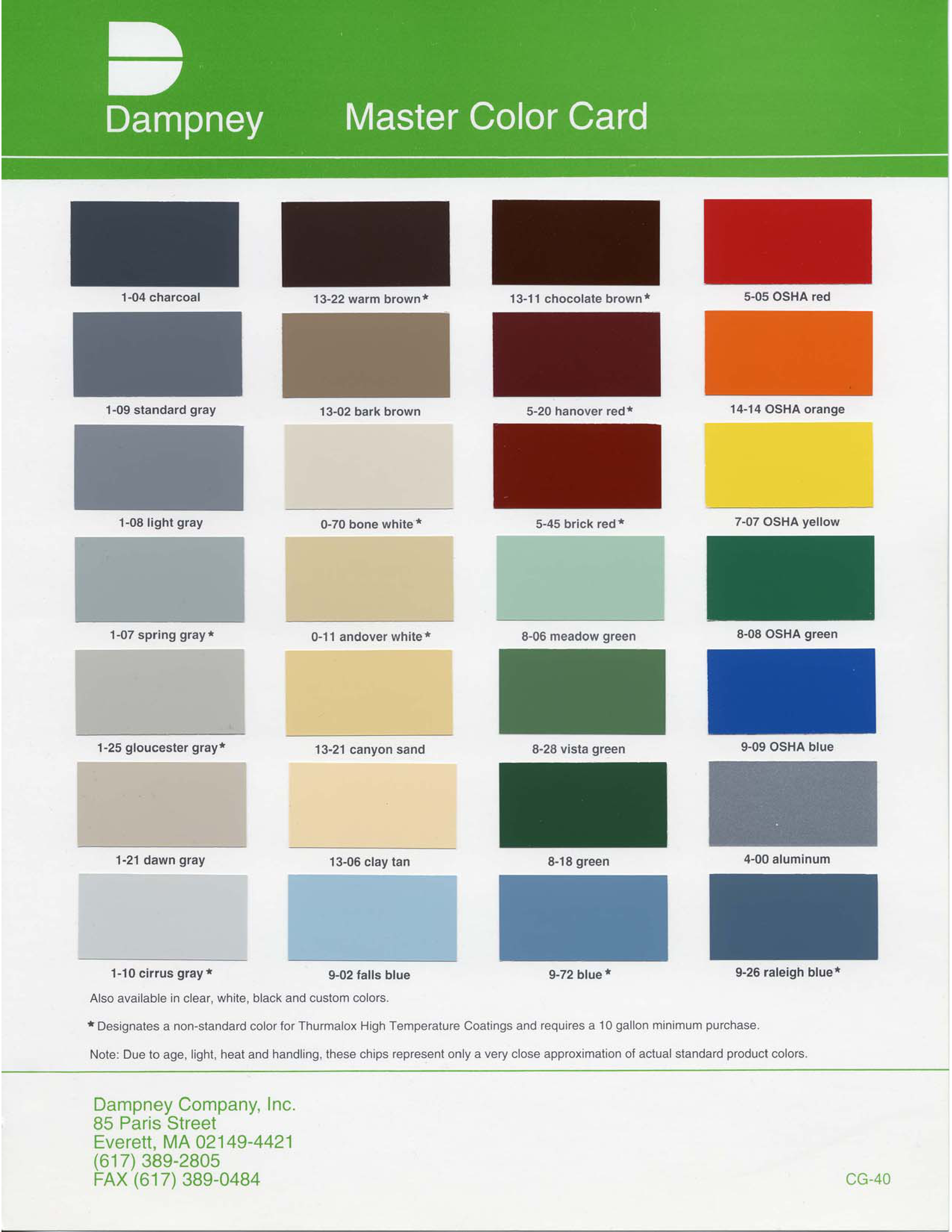
Tailor-Made Engineering Solutions (Tailor-Made Coating Solutions)
Another differentiator of Dampney is its research, development, and custom-coating manufacturing capability.
The manufacturer has a development laboratory, specialized manufacturing processes, and computerized color-matching systems.
These capabilities make it possible to evaluate formulations and protective systems tailored to specific operating conditions, substrates, and finish requirements.
Rather than simply selecting a catalog coating, the goal is to develop a protective solution tailored to the asset's needs.
Special developments are subject to technical evaluation, manufacturer validation, and manufacturing conditions.
Industrial Applications
Depending on the product and exposure conditions, Thurmalox technologies may be considered for the external surfaces of:
- Steam pipes and hot process lines.
- Industrial furnaces, heaters, and boilers.
- Heat exchangers and process vessels.
- Chimneys, gas ducts, and combustion equipment.
- Equipment in refineries, petrochemical facilities, and power generation plants.
Selection must take into account application and service temperatures, substrate, deterioration mechanism, surface preparation, film thickness, curing, and inspection requirements.
Aplika: Engineering Applied to Industrial Asset Protection
At APLIKA CONTROL CORROSIÓN S.A.S., we integrate specialized technologies and engineering criteria to assess corrosion-protection solutions tailored to actual operating conditions.
The Dampney Thurmalox line demonstrates how technology can expand industrial equipment protection options through three differentiating attributes:
Application to hot surfaces. Protection at extreme temperatures with color options. Development of tailor-made engineering solutions.
These capabilities provide options to optimize maintenance strategies, preserve asset integrity, and support operational continuity.
We protect and rehabilitate assets in service. We preserve operational continuity and reduce the economic impact of downtime.
Do you need to protect equipment operating at high temperatures?
Contact our technical team to evaluate high-temperature coatings, hot-surface application options, and systems with special color finishes.
APLIKA CONTROL CORROSIÓN S.A.S.
Engineering applied to asset integrity.
Technical Contact: +57 310 209 8850
Email: gerenciatecnica@aplika.com.co
Website: www.aplika.com.co
Engineering applied to asset integrity.